

Hello, fellow traders!
Follow us to get the latest information quickly.
Have a great day!
-------------------------------------
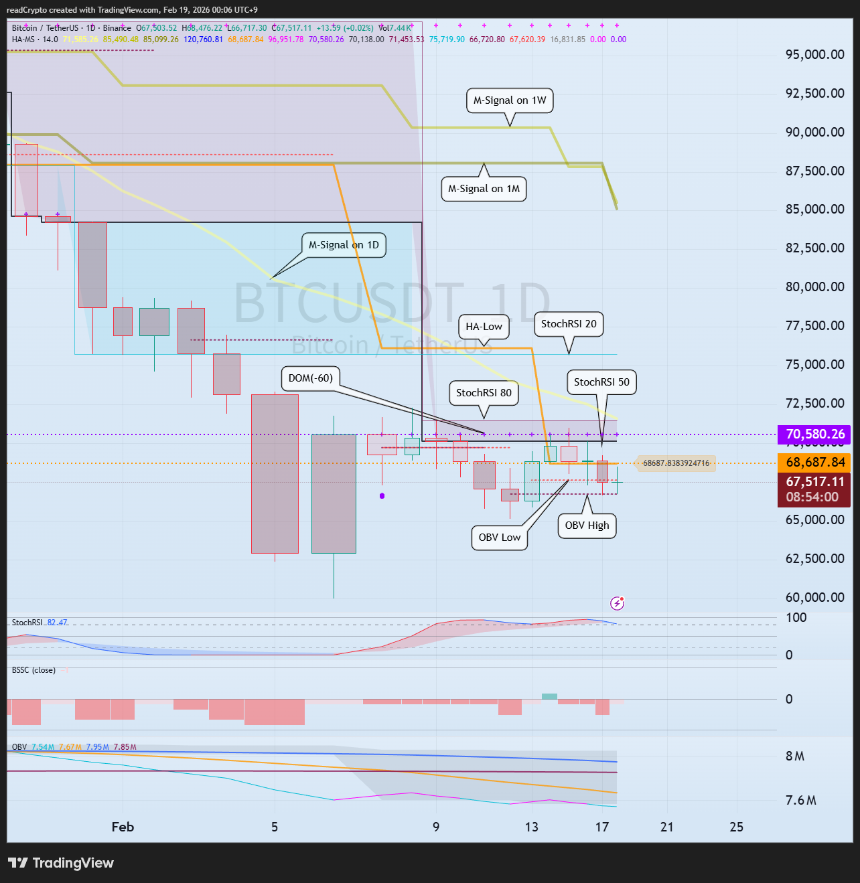
The M-Signal indicator on the 1M, 1W, and 1D charts is useful for monitoring the overall chart movement.
A major uptrend occurs when the M-Signal on the 1D chart > M-Signal on the 1W chart > M-Signal on the 1M chart.
Conversely, if the M-Signal on the 1M chart > M-Signal on the 1W chart > M-Signal on the 1D chart, a major downtrend is indicated.
-
The HA-Low and HA-High indicators are used for trading.
Therefore, the basic trading strategy is to buy in the DOM(-60) ~ HA-Low range and sell in the HA-High ~ DOM(60) range.
A rise in the HA-High ~ DOM(60) range is likely to lead to a stepwise uptrend, while a decline in the DOM(-60) ~ HA-Low range is likely to lead to a stepwise downtrend.
Therefore, trading should be done in segmented trading formats.
The HA-Low indicator is currently trending downward, which can be interpreted as a stepwise downward trend.
Since a stepwise downward trend ends in an uptrend, and a stepwise upward trend ends in a downtrend, we should monitor the current trend while preparing for an uptrend.
-
The price is declining in the HA-Low ~ DOM (-60) range (68,687.84 ~ 70,580.26).
Therefore, the key question is whether the price can rise to the 68,687.84 ~ 70,580.26 range.
However,
1. StochRSI 指标显示出从超买区域下降的迹象,
2。 BSSC 指标低于零,
3。 OBV 指标已跌破低线。 Therefore, we should consider a downward trend and consider countermeasures.
We've added the OBV High and OBV Low indicators, which correspond to the High and Low lines of the OBV indicator, to help you intuitively check the current status.
In other words, for an uptrend to continue, the price must remain above the OBV High.
Since the price is currently above the OBV High indicator, we can interpret this as indicating a potential uptrend.
However, since the OBV Low indicator is above it, the price must rise above and remain above the OBV Low indicator to demonstrate an uptrend.
If the price falls below the OBV High indicator, further可能会出现下降。
因此,总结上述内容,
1。 To buy, the price must find support in the 68687.84 to 70580.26 range.
2.如果没有,则可能出现下降趋势,应考虑对策。
3. The start of a step-down trend is likely to begin with a decline below the OBV High indicator.
-
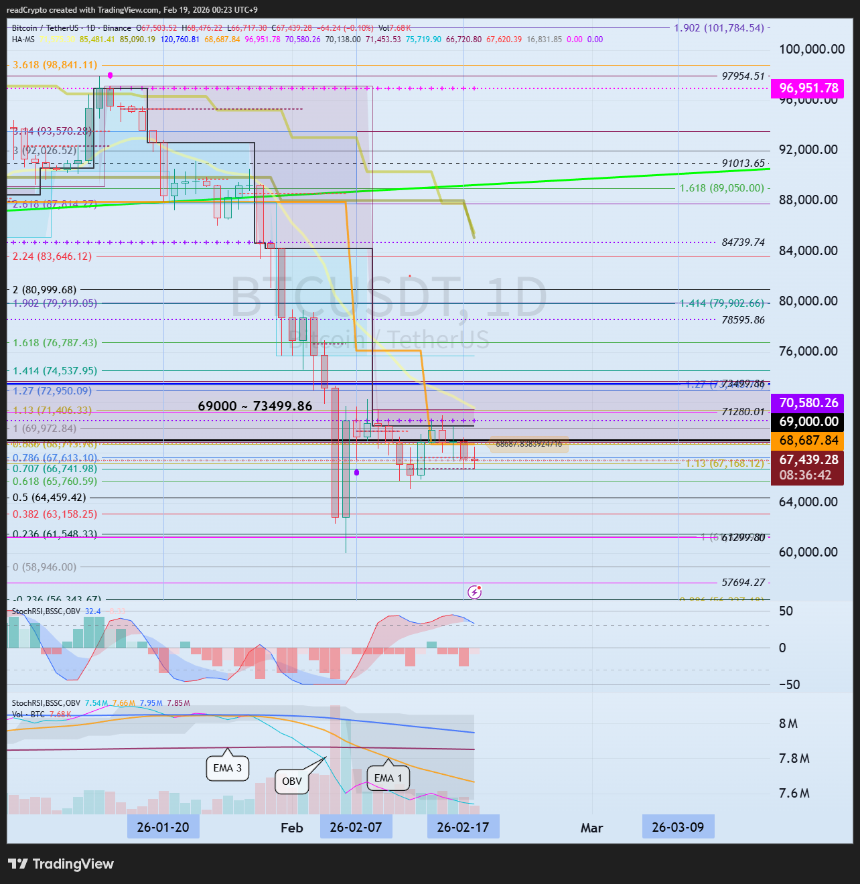
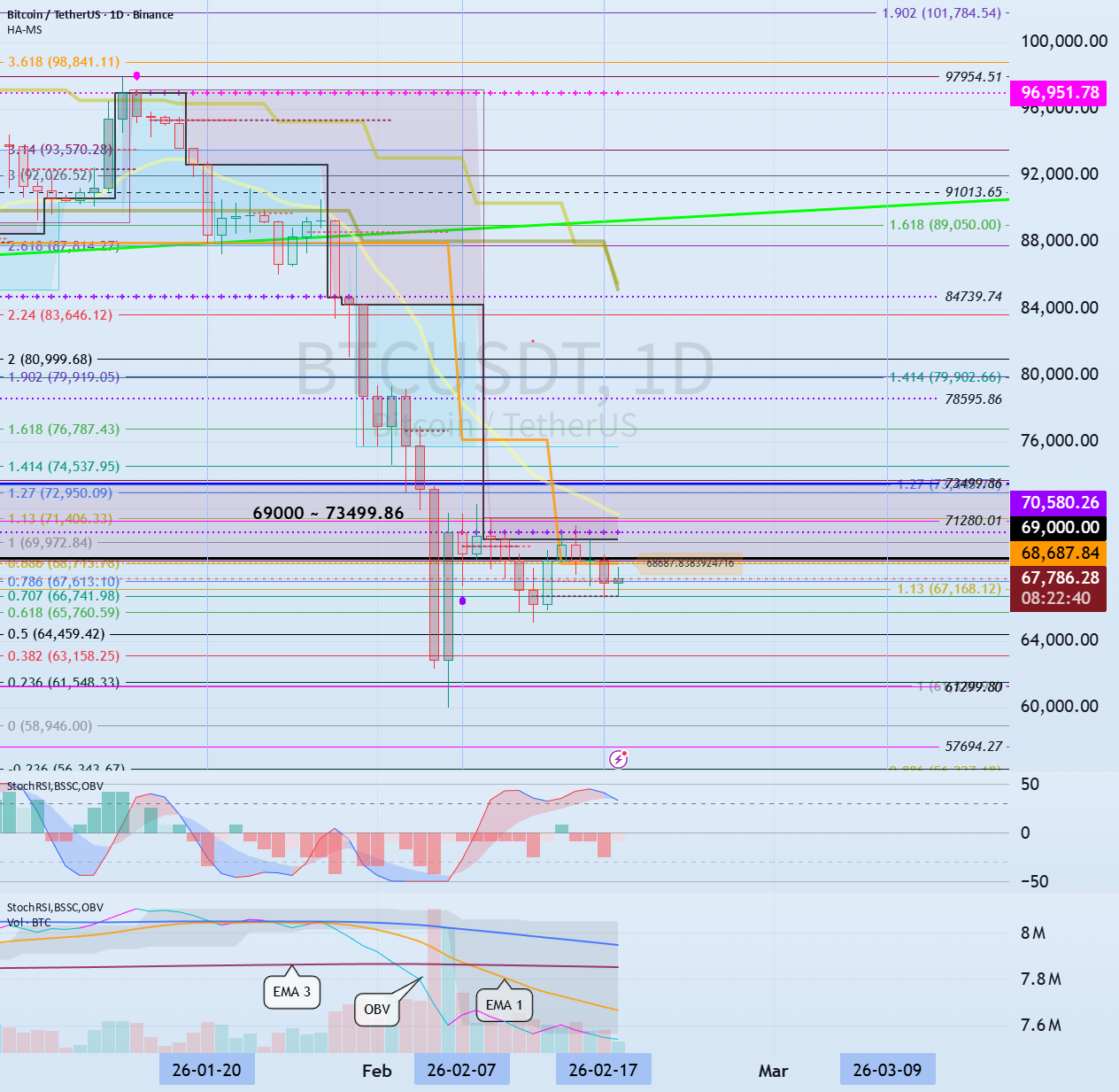
This volatility period is expected to last until February 18th, so movement during this period is crucial.
While it could find support at the OBV High indicator and rise dramatically, this is unlikely.
The next volatility period is around March 9th.
Therefore, we should watch for support and an upward trend around the 57694.27 to 61299.80 range before the next volatility period.
For an uptrend to begin, the StochRSI 20 indicator (75719.90) should provide support.
However, the key to trading is whether the price can buy when it finds support around the critical 69000 to 73499.86 range.
While it's good to buy at a lower price and see the price rise, it's difficult to buy when the actual price touches the 57694.27 to 61299.80 range.
Therefore, it's more likely to buy when the price finds support around 69000 to 73499.86, which meets the conditions for an uptrend.
The next most common buying point is when the price rises above the 75719.90 level, the StochRSI 20 indicator.
This is a psychological phenomenon, so regardless of where you buy, you should develop a trading strategy that suits your investment style.
-
Thank you for reading to the end.
I wish you successful trading.
--------------------------------------------------